

Gemini AI

Gemini AI is a family of advanced artificial intelligence models and AI-powered assistants developed by Google DeepMind. Rather than being a single chatbot or product, Gemini is a multimodal system capable of processing text, images, programming code, audio, and video.
This design allows it to interpret and integrate information across formats – a capability particularly useful in environments where businesses manage diverse data sources, such as product catalogs, customer reviews, marketing content, and transactional datasets.
Gemini serves as a central component of Google’s broader AI strategy. It is embedded across Google products, including Google Search, Google Workspace, Android, Pixel devices, and Google Cloud, and is also accessible through APIs, enabling developers and organizations to build applications using its underlying models.
Its widespread integration supports a variety of workflows, from drafting communications and summarizing documents to analyzing data and automating operational tasks.

History and development
Origins at Google DeepMind
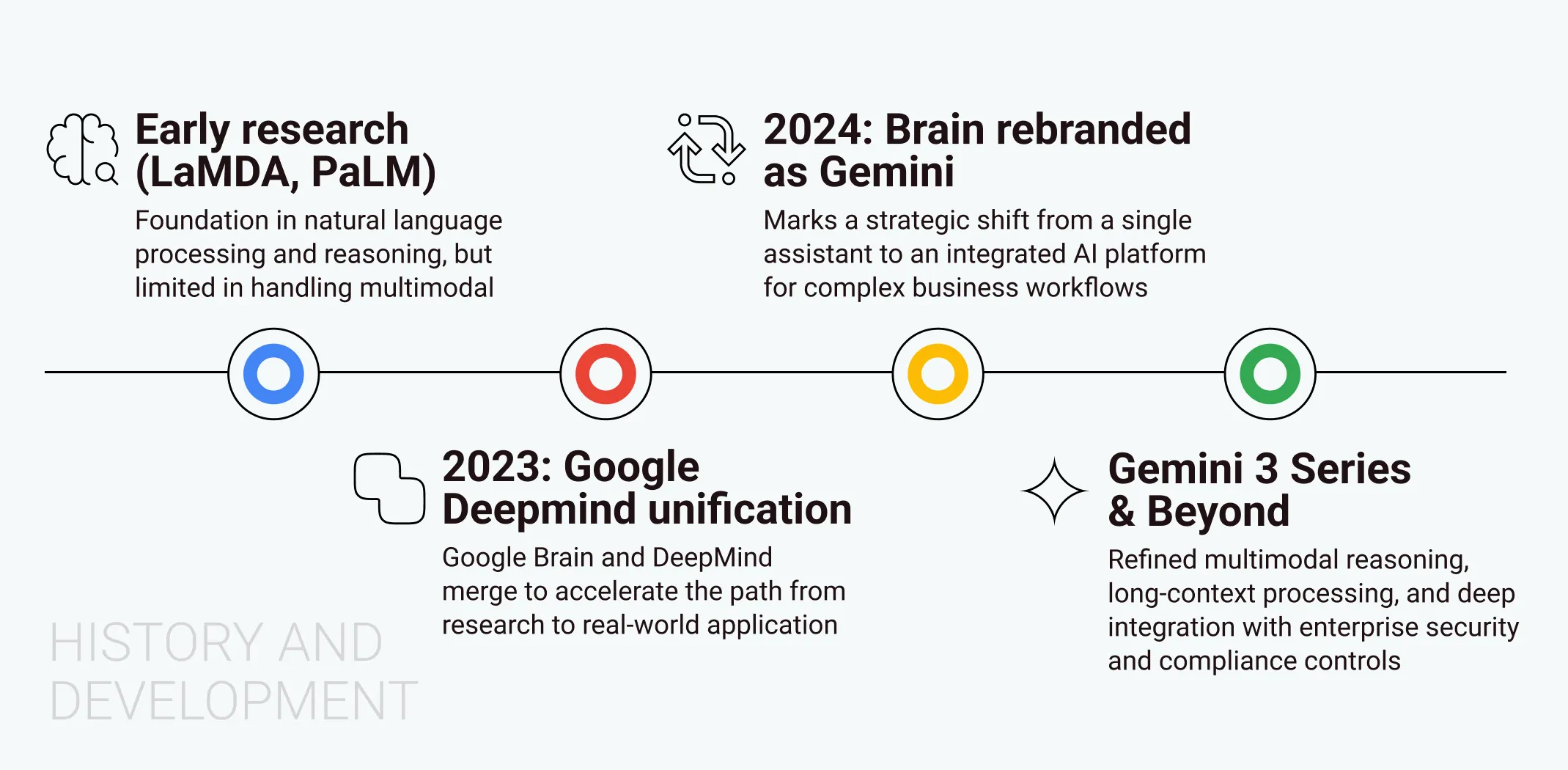
In 2023, Google merged its AI research divisions, Google Brain and DeepMind, forming a unified organization called Google DeepMind. The goal was to accelerate the development of AI models capable of moving from research into real-world applications more efficiently.
Gemini emerged as a multimodal AI platform, designed to process multiple types of information within a single model, while supporting complex reasoning and multi-step problem-solving. Its architecture emphasizes integration with Google’s products and infrastructure, allowing applications across business workflows, data analysis, and operational automation.
From LaMDA, PaLM, and Bard to Gemini
Gemini builds on previous Google AI research, including LaMDA, PaLM, and the Bard assistant, which provided insights into natural language processing, dialogue, and reasoning. While these predecessors demonstrated strengths in conversation and scaling model capabilities, they were limited in handling multimodal content.
In 2024, Google rebranded Bard as Gemini, marking a shift from a single assistant toward a platform that integrates AI across workflows, including document interpretation, spreadsheet analysis, and operational automation – applications particularly relevant for businesses managing large catalogs, customer data, and content pipelines.
Key milestones and releases
Gemini’s development progressed through several major releases, each enhancing capabilities for handling real-world tasks.
Early versions implemented a tiered model strategy, with smaller models optimized for on-device tasks and larger models for cloud-based, computationally intensive operations. Later updates expanded long-context processing, enabling analysis of full documents, codebases, and multimedia content in a single session.
The Gemini 3 series further refined multimodal reasoning, improved real-time responsiveness, and deepened integration with workflows commonly used in business, such as reporting, customer support, and product content management.
Features such as advanced security controls, data handling options, and compliance support were gradually introduced, making the platform suitable for regulated industries and high-volume operational environments.
Technical overview
Foundation models and multimodality
At its core, Gemini is a family of large multimodal foundation models. Foundation models are trained on a broad set of data to perform diverse tasks without retraining. Gemini comes in multiple variants: smaller models optimized for speed and efficiency, and larger models specialized in reasoning and complex problem-solving.
A distinctive feature is tool use: Gemini can access search engines, run code, query structured databases, and interact with enterprise or commercial systems. This allows it to combine learned knowledge with live or structured information, a functionality that enhances workflows in areas like inventory management, sales analysis, and customer insights.
Oversight is necessary, as tool access requires proper configuration and security controls to ensure accurate and compliant outputs.
Training methodology
Gemini’s training relies on extensive datasets, including publicly available text, licensed sources, code repositories, images, audio, and video, with strict exclusion of sensitive personal data. The process occurs in stages:
- Sequence prediction: The model learns patterns in text, code, and other modalities.
- Supervised fine-tuning: Human reviewers correct outputs and provide examples of optimal responses.
- Reinforcement learning with human feedback: Outputs are ranked and adjusted to align with preferences for reasoning, helpfulness, and tone.
Training is ongoing, with continuous evaluation, red-teaming, and automated testing to maintain safety, accuracy, and operational reliability, which is especially relevant for applications in ecommerce analytics, reporting, and content generation.
Reasoning, planning, and tool use
Gemini is designed for multi-step tasks. Internally, it can decompose problems, evaluate intermediate results, and generate final outputs that integrate multiple data sources. For instance, it can summarize sales data, compare trends over time, and produce plain-language reports for decision-makers.
Its tool integration allows businesses to:
- Access current market or inventory data
- Automate data analysis pipelines
- Query structured business databases
- Execute multi-step operational workflows
This combination of reasoning and tool use supports functions from merchandising and pricing analysis to content generation for ecommerce platforms, helping businesses turn raw data into actionable insights efficiently.

Business and ecommerce applications
Gemini AI is widely applied in business environments to enhance operational efficiency, support decision-making, and automate repetitive tasks. Its multimodal capabilities and ability to process long-context information make it particularly valuable for ecommerce businesses, which often manage product catalogs, customer interactions, sales analytics, and marketing content across multiple formats.
Internal knowledge management and decision support
Large organizations, including ecommerce platforms, accumulate extensive documentation such as policies, operational procedures, training materials, and historical reports. Locating relevant information can be challenging, especially when documents are unstructured or distributed across systems.
Gemini can connect to internal document repositories and answer questions in natural language.
For example, a manager could query the system about seasonal discount policies or supplier return conditions. Gemini can scan relevant sources, extract key information, and present it in concise summaries. This reduces time spent searching for information and supports data-driven decision-making in merchandising, inventory planning, and operational management.
By analyzing historical sales, website traffic, and customer behavior data, Gemini can also highlight trends or anomalies, allowing managers to focus on interpretation and strategy rather than raw data collection.
Customer support and service operations
Customer service in ecommerce often involves handling high volumes of inquiries, repetitive questions, and extensive interaction histories. Gemini assists support teams without replacing human agents, increasing efficiency while maintaining quality.
Key applications include:
- Conversation summarization: Gemini can summarize previous customer interactions before agents respond to new requests, saving time and improving consistency.
- Draft response generation: Based on company policies and tone guidelines, Gemini can suggest responses, helping agents maintain professional and uniform communication.
- Request classification: Incoming messages can be automatically tagged (e.g., refunds, shipping delays, product issues) to route them to the correct teams efficiently.
These capabilities reduce operational workload, enhance customer experience, and allow ecommerce teams to scale support without proportional increases in staffing.
Product content and catalog management
Ecommerce platforms often manage thousands of products, each with descriptions, images, specifications, and associated metadata. Gemini’s multimodal abilities allow it to generate or refine product descriptions using structured specifications and visual inputs.
Benefits include:
- Standardizing language across product listings
- Highlighting key features consistently
- Automating large-scale content updates
Gemini can also analyze customer reviews to identify trends, common complaints, or recurring praise. For instance, the system may detect frequent mentions of sizing inconsistencies or shipping delays, providing insights for marketing messaging, product improvement, and vendor negotiations.
Marketing, analytics, and operational insights
Marketing teams leverage Gemini to create, summarize, and analyze content efficiently. Applications include drafting email campaigns, rewriting product copy for diverse audiences, and generating reports summarizing the performance of previous campaigns.
By combining structured data with textual analysis, Gemini can provide:
- Performance summaries of marketing initiatives
- Insights from sales trends across product categories
- Evaluation of promotional strategies and pricing impacts
This reduces manual reporting work, allowing teams to focus on strategic planning, campaign optimization, and customer engagement.
Integration across Google products
Gemini is designed to work seamlessly within Google’s ecosystem, supporting both productivity and analytical workflows:
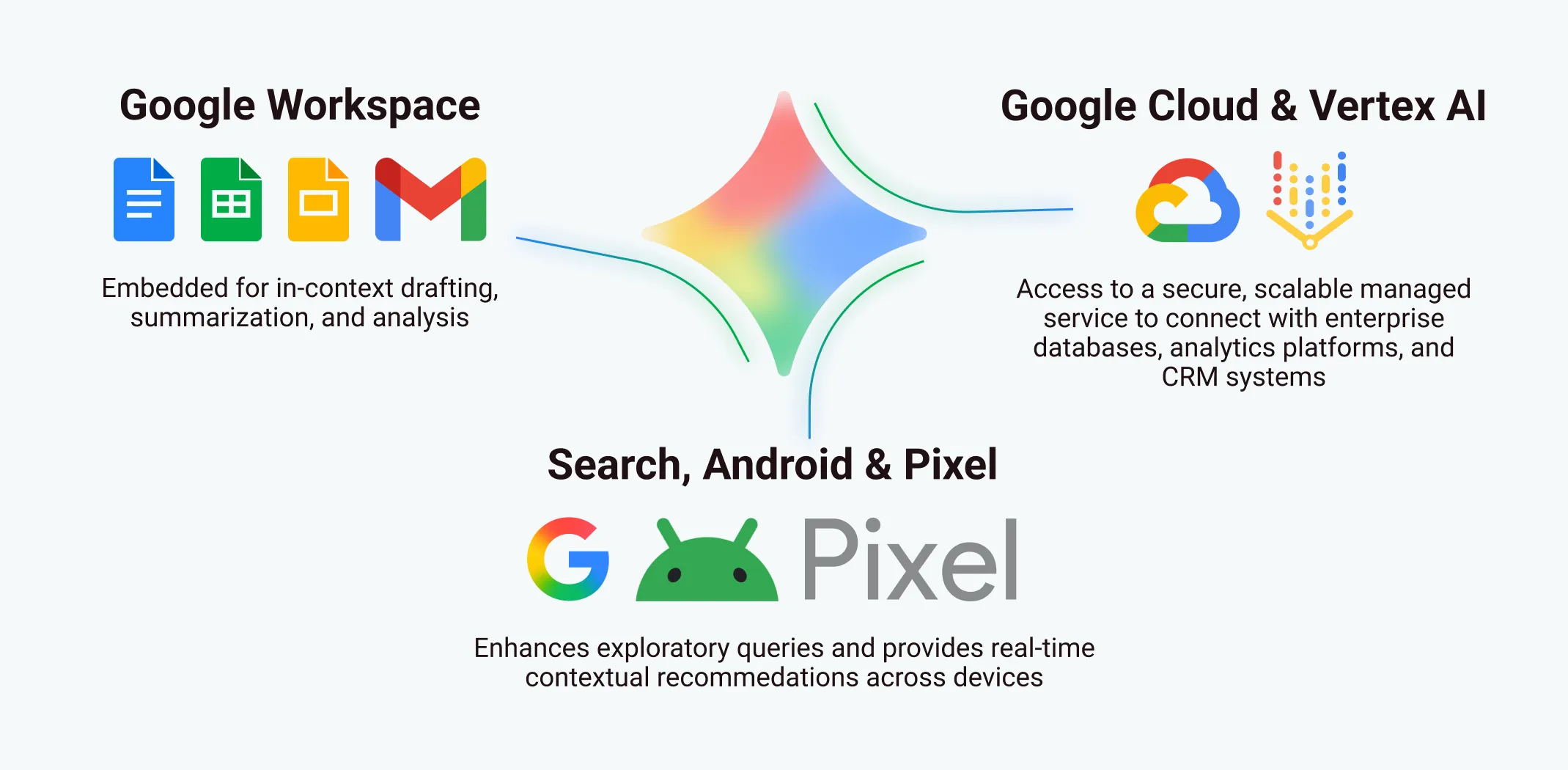
- Google Workspace: Embedded in Docs, Sheets, Gmail, Slides, and Meet, Gemini assists in drafting, rewriting, and analyzing content directly in familiar tools. For example, it can summarize a spreadsheet of sales metrics or generate a brief from meeting notes.
- Google Cloud and Vertex AI: Organizations can access Gemini models as a managed service, connecting them to databases, analytics platforms, or CRM systems. This is particularly useful for ecommerce operations that require secure, scalable AI processing without managing complex infrastructure.
- Search, Android, and Pixel devices: Gemini enhances exploratory queries, smart replies, and contextual recommendations, offering real-time insights across devices.
Through these integrations, businesses can embed AI-driven insights and automation directly into existing workflows, reducing friction between data analysis, content creation, and operational decision-making.
Developer ecosystem and API access
Gemini AI is accessible to businesses and developers primarily through APIs provided via Google Cloud and Vertex AI. These APIs allow organizations to embed Gemini into custom applications, enabling automation and insights across enterprise systems without requiring teams to manage the underlying infrastructure.
Key features for business use include:
- Tiered model access: Organizations can choose from different model variants, such as Pro or Flash, balancing cost, speed, and reasoning complexity. This allows ecommerce companies to allocate resources efficiently, using smaller models for high-volume tasks like product description generation and larger models for complex data analysis.
- Integration with enterprise systems: Gemini APIs can connect directly to databases, CRM platforms, analytics tools, and internal knowledge repositories. For example, an ecommerce platform could automatically generate insights from customer purchase histories or summarize supplier performance reports.
- Developer tools: Google offers SDKs for multiple programming languages and AI Studio, a browser-based environment for experimentation. This lowers the barrier to entry for teams building business applications, enabling rapid prototyping and iteration.
Cost management is a critical consideration. Usage-based pricing scales with requests and model size, which benefits small-scale experiments but requires monitoring for high-volume ecommerce operations. Businesses often implement caching, rate-limiting, and tier selection to control costs effectively.
Security and compliance features are particularly relevant for enterprise adoption. Gemini supports:
- Private networking
- Regional data processing
- Detailed logging and audit trails
These features ensure that sensitive customer, product, and financial data remain protected, which is essential for regulated industries and ecommerce platforms handling personal and transactional data.
Gemini AI vs competitors
Gemini AI competes with other advanced models, including ChatGPT, Claude, and open-source systems. From a business perspective, the comparison often revolves around workflow integration, operational reliability, and support for commercial processes, rather than benchmark scores alone.
Gemini AI vs ChatGPT
Both Gemini and ChatGPT serve broad audiences, but Gemini’s deep integration with Google Workspace, Cloud, and enterprise tools makes it particularly effective for structured, document-heavy business workflows.
Use cases for ecommerce and enterprise teams include:
- Summarizing internal reports and customer inquiries
- Analyzing sales trends and inventory data
- Automating content creation for product catalogs or marketing campaigns
ChatGPT, particularly GPT-5.2, excels in conversational tasks, collaborative drafting, and code review, making it suitable for iterative team workflows. However, organizations may need additional integration work if they do not already rely on Microsoft or OpenAI platforms.
- Gemini: Strong for multi-step, document-based analysis and operational automation
- ChatGPT: Strong for team collaboration, iterative content creation, and coding workflows
Gemini AI vs Claude
Claude emphasizes long-context reasoning and safety, making it ideal for industries such as legal, finance, and healthcare, where maintaining accuracy across large documents is critical.
In contrast, Gemini provides multimodal capabilities and integration with Google Cloud workflows, enabling organizations to process images, spreadsheets, and structured datasets alongside text.
Business implications include:
- Claude: Predictable outputs for compliance-sensitive tasks
- Gemini: Richer multimodal insights and operational automation for ecommerce and enterprise analytics
Gemini AI vs open-source models
Open-source models offer maximum customization and control, appealing to organizations with strong IT teams or strict data residency requirements. However, deployment often involves substantial infrastructure, monitoring, and maintenance overhead.
Gemini, as a managed service, reduces operational complexity, allowing businesses to deploy scalable AI workflows quickly.
- Open-source: Best for autonomy and internal control
- Gemini: Best for efficiency, rapid deployment, and ecosystem integration
Overall comparison perspective
Performance is context-dependent, and no single model dominates all tasks:
- Gemini: Best for document-centric workflows, analytics, and Google-native environments
- ChatGPT: Best for conversational, iterative, and coding-intensive tasks
- Claude: Best for long-context, safety-critical, and compliance-focused applications
- Open-source models: Best for custom, internally controlled environments
Organizations often adopt multiple AI models to address different operational needs rather than relying on a single solution.
Ethics, safety, and responsible AI
Ethics and safety are central to Gemini’s design, particularly in business applications where AI outputs can influence decision-making and customer interactions. Google applies its internal AI principles to Gemini, emphasizing:
- Harm prevention: Minimizing outputs that could mislead users or generate inappropriate content
- Bias reduction: Evaluating model behavior across languages, demographics, and business contexts
- Privacy protection: Ensuring that sensitive consumer or organizational data is handled securely
Despite these safeguards, organizations are advised to treat Gemini’s outputs as assistive guidance rather than definitive answers. This is especially important in ecommerce, where automated product descriptions, marketing messages, or customer support summaries must be reviewed for accuracy and compliance.
A known limitation is hallucination, where the model confidently generates incorrect information. Gemini mitigates this through careful training, cautious phrasing, and, in some cases, citations or confidence indicators. Nonetheless, human oversight remains essential, particularly for business-critical or consumer-facing operations.
Privacy and data governance are highly relevant in enterprise contexts. Gemini provides configurable controls over data usage, storage, and processing, but effective implementation requires organizations to actively manage permissions and monitor interactions with sensitive datasets, such as customer orders, payment records, or proprietary analytics.
Limitations and criticisms
While Gemini offers advanced capabilities, it has limitations that are important for businesses to consider:
- Domain specificity: Performance may decline in highly specialized areas, such as industry-specific terminology or niche ecommerce verticals.
- Language support: English generally receives the strongest performance; multilingual enterprise workflows may encounter inconsistencies.
- Regional availability: Some features are restricted by legal or technical constraints, which may limit global deployment for international ecommerce teams.
- Closed-source nature: Gemini’s internal mechanisms and training data are proprietary, limiting independent auditing. While this protects intellectual property and security, organizations must rely on Google’s governance.
- Ecosystem dependence: Deep integration with Google products enhances workflow efficiency but may increase reliance on a single vendor, potentially limiting flexibility for enterprises that operate across multiple platforms.
Businesses considering Gemini should weigh these factors against the operational advantages of managed, integrated AI services, particularly in fast-moving commercial environments.
Future roadmap and expected developments
Gemini’s development roadmap emphasizes capabilities that align with enterprise and ecommerce needs:
- Stronger agentic behavior: Gemini may evolve to plan, remember, and execute multi-step workflows autonomously. This could allow ecommerce platforms to automate tasks such as inventory monitoring, content updates, and sales trend analysis over days or weeks, reducing operational overhead.
- Real-time multimodal interaction: Future models may handle live audio and video, enabling interactive meetings, customer service simulations, or video-based product analysis. For example, an ecommerce team could review video product demonstrations and extract key features automatically.
- Expanded context windows: Longer context handling will improve Gemini’s ability to process entire product catalogs, customer histories, or large-scale enterprise reports in a single session. This is especially relevant for multi-channel ecommerce operations that integrate sales, inventory, and marketing data.
- Enhanced safety, fairness, and trust mechanisms: As Gemini becomes more embedded in critical workflows, maintaining responsible use will remain a priority, ensuring outputs are reliable, unbiased, and compliant with regulations.
These future developments position Gemini as a practical tool for business intelligence, operational efficiency, and ecommerce innovation, rather than just a general-purpose AI assistant.
Are you ready to become an owner
of a profitable online business?
Free Dropshipping Guide